

For a no-equipment warm-up, start with Two Truths and a Lie, Would You Rather, or Lines and Blobs. If everyone has paper, choose 20 Questions, Pictionary, or Telephone Pictionary. For a larger group, use the simultaneous movement of Lines and Blobs, a team format such as Fishbowl, a hidden-role round such as Werewolf, or trivia. If you want the game to manage prompts and scoring, choose a browser version of the same format.
How to choose the right party game for your friends
Start with the kind of participation your friends want and the materials already available. Some formats ask one person to perform while others guess; others let everyone answer, draw, discuss, or move at the same time. Match the choice to the room’s energy and to how comfortable the group is with taking the spotlight.
- Quiet and conversational: Two Truths and a Lie, Would You Rather, or 20 Questions.
- Active and performative: Charades, Lines and Blobs, or Fishbowl.
- Creative at the table: Pictionary, Telephone Pictionary, or Categories.
- Discussion and deduction: Werewolf.
- Broad team participation: themed trivia.
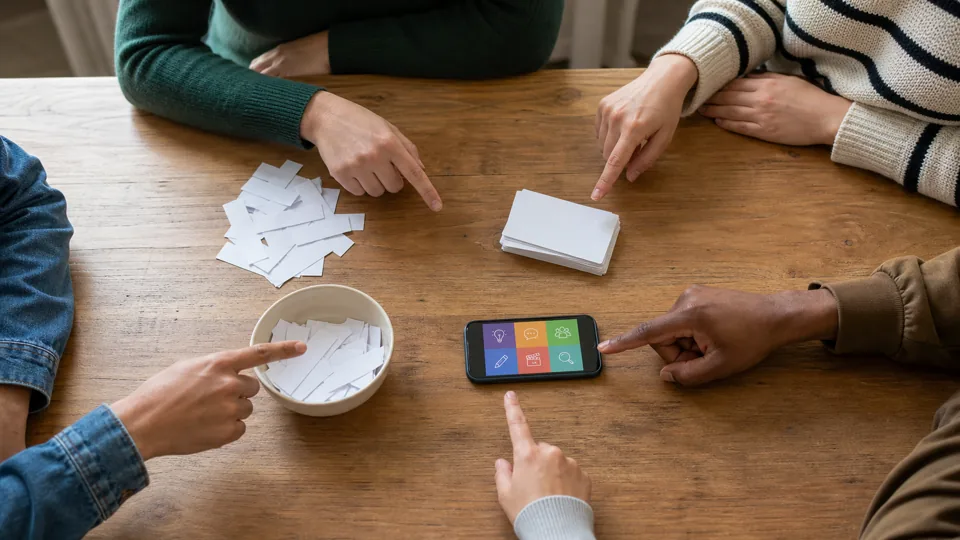
Give the core turn in one or two sentences, then start a short round. If friends are still settling in, a low-pressure question game keeps everyone talking; when the room wants more energy, switch to acting, drawing, or movement.
Easy party games with no equipment
These games need voices, gestures, or a way to count points—nothing to print or buy. They are useful when friends have just arrived or when the group wants to play immediately.
1. Two Truths and a Lie
One player says three facts about themself: two are true and one is a lie. Everyone else identifies the lie. A player who guesses correctly earns one point and goes next.
2. Charades
Choose a player to act out the answer to a prompt using gestures but no speech. The first friend to guess correctly takes the next turn. Prompts can be answers to simple questions, such as a favorite book, film, or activity.

3. Would You Rather
Ask a choice between two alternatives and assign one side of the room to each option. Everyone moves to the side that represents their choice, then friends from both sides explain their reasoning and try to persuade one another before the next question.
4. Lines and Blobs
Ask everyone to arrange themselves in a line or gather in groups according to a prompt. A line might follow birthday order or number of siblings; blobs might group people by clothing color or a shared preference. Repeat with new prompts so friends keep mixing into different arrangements.
Party games with paper and pens
A stack of sticky notes, loose paper, or small notebooks opens up guessing, drawing, and word games. Put the materials out before the first round so every player can start at the same time.
5. Who Am I?
Write a familiar person or topic on a card for each player and attach it to that player’s back or forehead without showing them. Friends circulate and ask questions until they identify their own card. This format works from five players.
6. 20 Questions
With four or more players, divide into teams of two to four and prepare cards with related words or topics. One player draws a card, and the other players ask questions that can be answered only with yes or no and must identify the topic within 20 questions.

7. Telephone Pictionary
Telephone Pictionary works best with at least six players, each with a notebook or stack of paper. Everyone writes a phrase, passes it left, and draws the phrase they receive without using words or letters. Hide the phrase and pass again. The next player sees only the drawing and writes what they think it means. Alternate drawing and guessing until the papers return or the pages run out, then reveal each chain from the first phrase to the final guess.
8. Categories
Agree on 5–10 categories and draw them as columns on every player’s paper. Choose one letter and set a 2–3-minute timer. Everyone writes one matching answer per category, then reads the results aloud. Score 10 points for a valid unique answer, 5 for a valid answer someone else also wrote, and 0 for a blank, invalid, or unfinished entry.
Party games for large groups and teams
For a bigger room, choose a format that gives people a shared problem instead of a long line of isolated turns. Teams, simultaneous voting, and group discussion keep more players involved.
9. Fishbowl
Split into two teams and have every player put three words or phrases in a bowl. Use the same prompts for four rounds: describe them with speech but no gestures or parts of the word; act them silently; give one-word clues; then use sounds without words. Teams score one point for every correct guess. Use 30–60-second turns and mix easy, difficult, and group-specific prompts. Fishbowl suits four or more players, usually takes 30–60 minutes, and the team with the highest total after round four wins.

10. Werewolf
Randomly assign hidden roles: at minimum, a werewolf and villagers. The villagers try to identify the concealed werewolf before the villagers are eliminated. More elaborate variants add extra roles, but the simple version is enough for a free deduction game built around observation and discussion.
11. Trivia
Choose broad categories the group recognizes, name a host, and play individually or in teams. Prepare 7–10 questions per round. The host asks each question, checks the answer, and awards a point; allow about two minutes per question to keep the game moving. The person or team with the most correct answers wins.
12. Pictionary
Prepare cards with words, people, or ideas that can be drawn. Split into two teams, or divide a bigger party into smaller groups and split each group in two. One player takes a card and draws its subject while the group guesses; add a timer for a faster challenge.
Browser party games to play with friends
A browser version is useful when you want prepared prompts, a visible timer, hidden information, or automatic scoring. Match the digital game to a format the group already wants: word explanations, deduction, or trivia.
For more device-specific options, see RoomPlay’s guides to party games on one phone and online party games for remote groups.

Timed word explanations
If the spoken-clue round in Fishbowl is the part your group wants, Alias in RoomPlay provides team words and a timer in the browser.

Open Alias, split into teams, and race the timer.
Secret words and hidden roles
If your group wants the discussion of Werewolf plus a word to uncover, Werewords in RoomPlay gives the Mayor a secret word while a hidden Werewolf remains in the group.

Use one phone to manage the secret word and roles.
Hosted trivia with automatic scores
Quiz in RoomPlay lets a host create a room and friends join by link or QR code; the game then handles rounds and scores.

Create a room, share the invite, and let RoomPlay track the score.