

In the standard Wavelength game, two teams take turns. The active team’s Psychic secretly sees a colored target on a dial and gives a clue that belongs somewhere between the two ends of a spectrum card. The team discusses the clue, fixes the dial, and the other team predicts whether the target is left or right of that dial. The active team earns 2–4 points for landing in the target; a correct opposing prediction earns 1 point unless the active team hits the center.
What is the Wavelength game?
Wavelength is a social guessing game for two teams. It is not a trivia question with one factual solution: the interesting part is whether a group interprets a clue in the same way as its Psychic. A card establishes a range between opposite concepts, and the clue should indicate a location along that range rather than simply name an endpoint.
The physical game uses a dial with a concealed colored target. The target’s center is worth the most, so a team is trying to translate a shared impression into a precise position. The other team hears the same clue and can gain a point by deciding whether the active team’s dial stopped too far left or too far right.
Standard play uses two roughly even teams. The published game is commonly listed for 2–12 players, although its cooperative mode is the intended way to use a small group. The table version is played in the box with the dial device, spectrum cards, score markers, and a left/right guessing marker.
Wavelength game setup
Put the dial device in the box tray and place the two score markers and the guessing marker in their slots. Divide players into two teams, then choose a first Psychic for each side. The rules give the second team a one-point start to offset the advantage of going first.
Before a turn begins, agree on a simple practical point: the Psychic must be able to operate the screen without anyone seeing the target. The rest of the group needs to see the card’s two concepts, but not the wheel behind the screen.
- Make two teams of roughly similar size.
- Choose the first Psychic for each team and place the score markers.
- Give the active Psychic the device and the deck of spectrum cards.
- Keep the target covered whenever the Psychic randomizes the wheel or passes the device to teammates.
How to play Wavelength: the four phases
Each turn follows the same sequence. Keeping the order clear matters because the Psychic’s private knowledge and the other team’s left/right decision are what make the round work.
1. Psychic phase
The active Psychic closes the screen, selects one side of a double-sided spectrum card, and makes its two ends known to both teams. With the screen still closed, the Psychic randomizes the target location. They open the screen privately, decide where the target sits between the concepts, give a clue, close the screen, and then stop communicating.
2. Team phase
The Psychic’s teammates discuss the clue and turn the red dial to the location they believe the Psychic intended. They can debate freely and anyone on the team may move the dial. When they agree, they announce that their position is final.
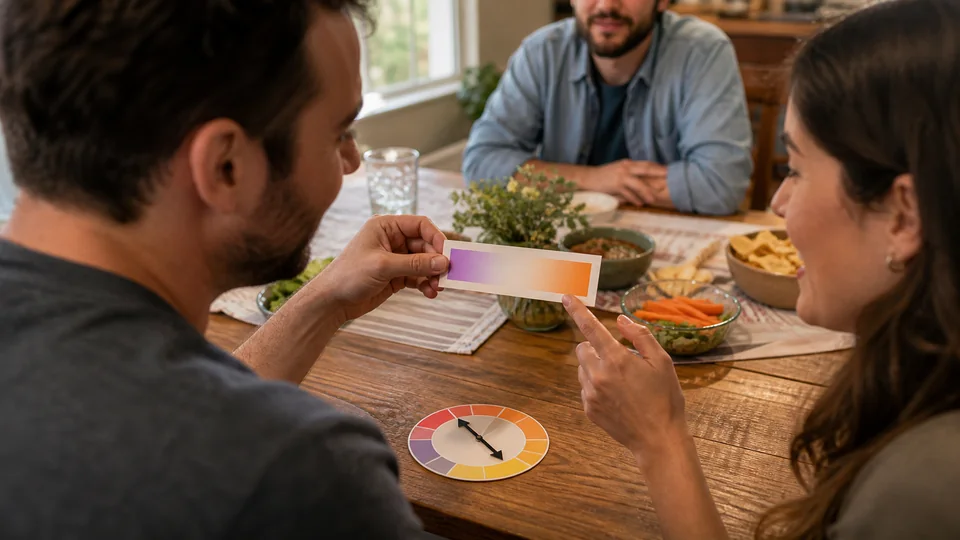
3. Left/right phase
The opposing team now makes a short, binary decision: is the center of the hidden target left or right of the dial’s final position? They place the guessing marker beside the card. They are predicting the target’s center, not merely whether any colored edge is visible.
4. Scoring phase
The Psychic opens the screen. The active team scores the number printed on the colored wedge where the dial lands, from 2 to 4 points. If the dial lies exactly on a boundary, the active team takes the better result. The other team scores 1 point for a correct left/right call, except when the active team hits the 4-point center.
Wavelength rules for clues, scoring, and winning
A good clue gives the team a single thing to place on the spectrum. The official rules restrict shortcuts that would turn the round into coded instructions. The clue should be one thought, relate to the card’s concepts, and refer to something that exists outside the immediate game. Do not use the words on the card, their synonyms, rhymes, or numbers to signal a location.
The rulebook also recommends concise clues and avoiding qualifiers such as “very” or “almost.” After the clue, the Psychic remains silent and keeps a neutral expression; there are no clarifications once the team begins to discuss. That silence protects the central challenge: reading the clue rather than reading the clue giver.
Teams normally alternate turns with a new Psychic each time. The game ends once a team reaches 10 points, with the higher score winning. If the scores are tied at that point, each team takes a sudden-death turn; compare the points from those turns, including any left/right point, and repeat if needed.
There is also a catch-up rule. If the active team scores 4 points yet remains behind after scoring, it immediately takes another turn with a different Psychic. This can create several consecutive turns for a trailing team, so a lead is not automatically safe.
Cooperative Wavelength for two players or a small group
The cooperative mode removes the competition: everyone plays as one team, so skip the left/right phase. It works especially well with 2–5 players, though the rulebook allows any group size. Players rotate the Psychic role and use the same core process of clue, discussion, dial placement, and reveal.
Start with seven random spectrum cards. When the deck runs out, the session ends and the group compares its total with the cooperative score chart. In this mode, the center wedge is worth 3 points rather than 4, but a center hit adds a bonus card to the deck, creating one additional round.

For a first game, cooperative play is useful because every discussion becomes shared practice. Switch to two teams once the group wants the extra tension of the left/right prediction and the catch-up rule.
Wavelength game online: run a spectrum guessing round in a browser
A shared-screen browser format works best when everyone is together. Choose a clue giver, show the spectrum to the group, keep the target hidden from everyone except that player, then let the group settle on a position before revealing it. You can use the official scoring system or play cooperatively as a quick warm-up.
RoomPlay has a Wavelength game page for a one-phone, spectrum-and-association round. It is a useful option when a group wants to start without setting up a physical dial. For a different word-based team format, see Alias; for a clue-and-team game played through a shared room, see Codenames.

Open Wavelength on one phone and take turns giving clues for the group.
Wavelength game FAQ
How many players can play Wavelength?
The published game is commonly listed for 2–12 players. Standard play is two-team competition; the cooperative mode is particularly suitable for 2–5 players.
What does the other team do during a Wavelength turn?
After the active team finalizes its dial, the other team guesses whether the center of the hidden target is to the dial’s left or right. A correct call scores 1 point unless the active team hit the 4-point center.
Can the Psychic explain a clue after giving it?
No. Once the clue is given, the Psychic should stop speaking and avoid signals or reactions. The team has to interpret the clue without extra help.
How do you win Wavelength?
In standard play, the game ends when a team reaches 10 points and the higher score wins. A tie is resolved with sudden-death turns. Cooperative play ends after the starting deck is used, with bonus cards added for center hits.