

Family Feud Game Rules at a Glance
Two teams compete to name responses that appeared most often in a survey. A response earns the points assigned to it on the board; the more popular the response, the more it is worth. The familiar television format uses a face-off to decide which team controls the board, three strikes to create a steal opportunity, and a final Fast Money bonus round.
For a home game, keep the core mechanic and decide the details before the first question: how many rounds to play, whether later rounds are worth double or triple, and the score that wins. That makes the game easy to scale for a short warm-up or a full game night.
How to Set Up a Family Feud Game
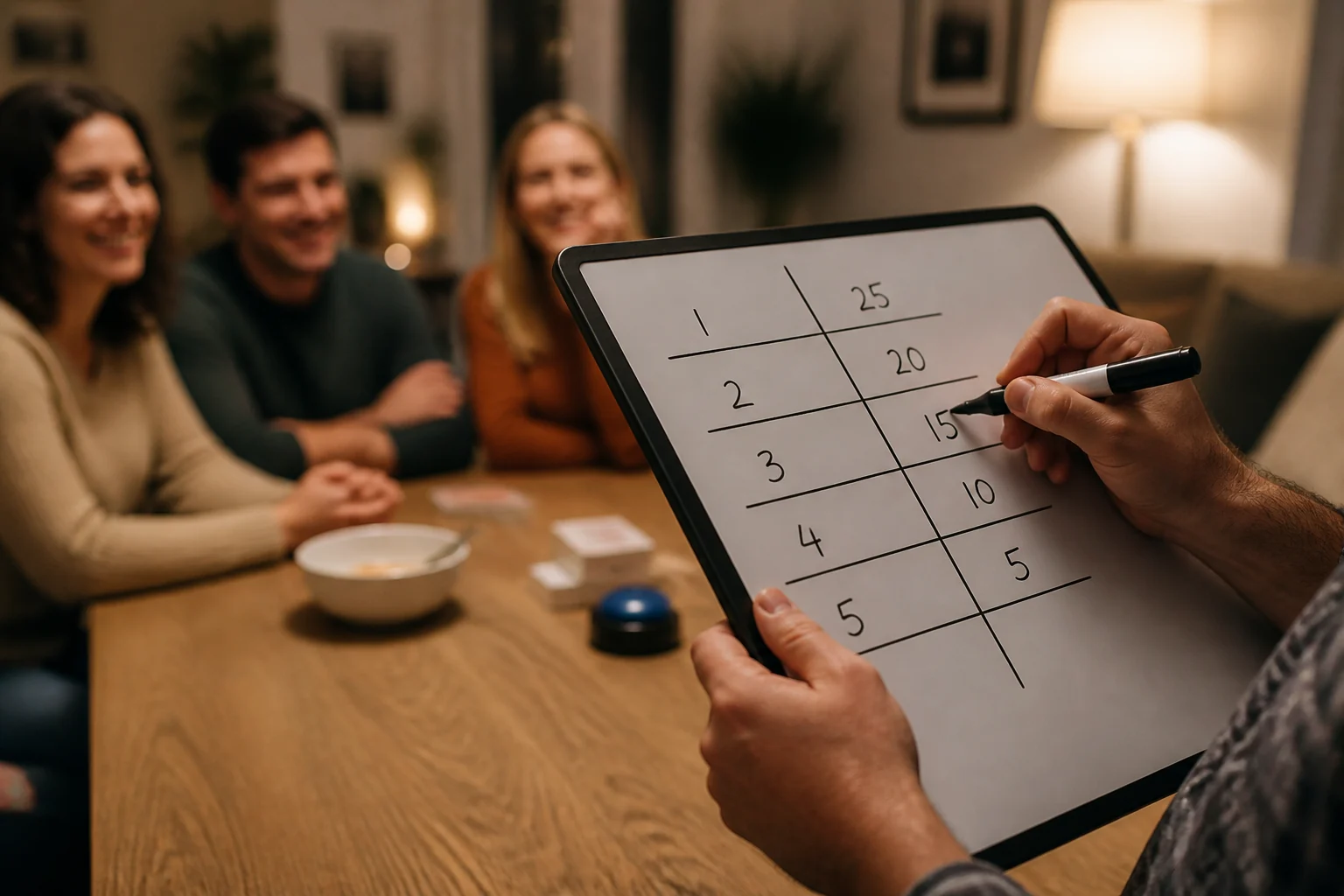
Choose two teams and a host. Three to five players per team gives everyone a chance to take a face-off and a regular turn, but smaller teams work too. Each team should agree on a fixed answering order so the host always knows whose turn it is.
Prepare a question board for each round. It needs the prompt, a ranked set of accepted responses, and the point value for each one. A whiteboard, paper cards, a slide deck, or a browser board can all do the job. Add a visible score area and three strike marks for the team currently playing.
- Host: reads prompts, judges duplicates, reveals responses, and tracks strikes.
- Board: keeps the ranked responses hidden until they are guessed.
- Buzzer or signal: decides who speaks first in a face-off; a bell, hand raise, or single key works.
- Survey results: use a small poll of your own group, a prepared question set, or a game that already has a board.
For an in-person group, the house party games collection is a useful place to choose what to play next once the survey rounds are over.
How a Family Feud Round Works
- Start a face-off. One player from each team comes forward. The host reads the question, and the first player to signal gives a response.
- Compare the first responses. If the first response is not the highest one on the board, the opposing player gets a chance. The team with the higher-ranked response takes control; in a TV-inspired version, it may choose to play or pass.
- Play the board. The controlling team answers in order, trying to reveal every remaining response. Keep the running value of the revealed board visible.
- Mark misses. A response that is not accepted earns a strike. After three strikes, the other team gets one chance to name any unrevealed response.
- Resolve a steal. A correct steal takes the points on the board; an incorrect steal leaves them with the team that built the board. State which home rule you are using before play so there is no surprise at scoring time.
- Move to a new face-off. Rotate the players who come forward and repeat until the planned number of rounds is complete.
Family Feud Questions for a Home Game

The best question asks for several plausible, everyday responses. Before presenting it as a survey question, collect responses from people outside the playing teams, group close duplicates together, and rank the results by how often they occur. Do not label a made-up list as survey data.
These prompts are ready to poll for your own board:
- Name something people do before going to bed.
- Name something you might keep in a kitchen drawer.
- Name a reason someone could be late to work or school.
- Name something people bring to a picnic.
- Name a place where people wait in line.
- Name something people check before leaving the house.
- Name a food that is hard to eat neatly.
- Name something that can wake you up in the morning.
- Name a thing people do when a guest is about to arrive.
- Name something people might forget when packing for a trip.
Theme the prompts for a birthday, a workplace, a holiday, or a classroom by keeping the same broad-response principle. Avoid questions with one obvious factual result; the fun comes from predicting a group’s habits, not recalling trivia.
Fast Money Rules for a Home Game
Fast Money is the two-player bonus round that follows the main game in the TV format. The first player gives quick responses to a small set of new survey questions. The second player then answers the same prompts without hearing the first set; when both choose the same response, the second player gives a replacement.
For a home version, use five new questions and a clear timer. Decide the total needed for the bonus before the game begins, then add the points from both players’ results. The host should prepare the board in advance and keep the first player’s responses hidden from the second.
If your group prefers head-to-head knowledge questions instead of a survey board, switch to a RoomPlay Quiz after the final round.
How to Play Family Feud Online

For a Family Feud game online, give one person the host role and make the board visible to everyone. A video call works with a shared presentation, while a browser game can handle the board and joining flow directly. Keep the call open for reactions if the group is remote, and agree on how players signal for a face-off before the first prompt.
RoomPlay’s Family Feud game is built for the survey-board format: open a room, share the join link or QR code, and let the game run the group round. For more remote formats, browse online party games.

Open the board, invite your group, and move from the first face-off to the final round in the browser.
Family Feud Game FAQ
How many people do you need to play?
Two teams are enough. Three to five players on each side keeps turns moving, though two-versus-two works for a compact game.
What happens after three strikes?
The opposing team gets one chance to name an unrevealed response and steal the points collected on that board.
Do you need to survey 100 people?
No. For a home game, a smaller poll is practical. Record how many people gave each response, rank the results, and tell players what your points represent.
Can you play without a buzzer?
Yes. Use a bell, a raised hand, a chat message, or a host-selected order for the face-off. The important part is choosing one method before play begins.